
In July 2026, the International Maritime Organization (IMO)’s new International Code of Safety for Maritime Autonomous Surface Ships (MASS CODE) officially came into force. As the world’s first comprehensive regulatory framework for maritime autonomous ships, the new code not only reshapes the technical standards for marine radar, but also points the way for domestic brands to break through in the high-end market.

Core of the New Code: Four Dimensions Reshaping Radar Standards
The new MASS CODE establishes a new technical system around autonomous navigation safety from four core dimensions, applicable to all cargo ships with autonomous/remote functions.
1. Dual independent redundant radar configuration: The new code mandates that medium and large vessels must be equipped with two completely independent radar systems using heterogeneous band combinations (such as S-band + X-band), so as to balance long-range detection and high-precision target capture in severe weather. It also sets higher requirements for radar display sizes to ensure observation clarity during remote monitoring.
2. Full-dimensional data interoperability and verification: To meet the needs of intelligent navigation, the new code requires radar to be deeply integrated with core equipment such as gyrocompasses, AIS, and electronic chart display and information systems (ECDIS), and to support the NMEA 2000 protocol. A newly added mandatory data verification function requires radar to automatically complete cross-sensor data comparison before operation, eliminating navigation decision errors caused by data deviations at the source.
3. Tightened all-weather reliability standards: The new code raises the equipment stability threshold, requiring radar failure-free operating time of no less than 8,000 hours, and antenna and transceiver units to meet IP66 or higher protection ratings to withstand extreme marine environments. In addition, all newly installed radars must be equipped with a performance monitor as standard to monitor equipment status in real time and provide early warnings of performance degradation.
4. Remote controllability and safety adaptation: This is a core breakthrough of the new code. Radar must support real-time interaction with a remote control center (ROC) and provide remote parameter debugging, fault alarm, and data backhaul functions. At the same time, the new code sets quantitative requirements for detection accuracy; for example, under sea state 3, the detection range for small fishing vessels of around 10 meters must be no less than 4.9 nautical miles, to meet the full-scenario navigation needs of unmanned ships.

Yonzoe Ushers in Domestic Development Opportunities: The New Code Points Out the Path Forward
For a long time, domestically developed radars have been concentrated mainly in the mid- and low-end markets. The new MASS CODE unifies global technical thresholds, breaks the standard barriers of overseas brands, and provides a clear path for domestically developed radars to achieve leapfrog development.

Product Adaptation: Yonzoe Radar Meets the New MASS CODE Requirements
With its forward-looking technology layout, Shanghai Yonzoe’s core products have been deeply adapted to the stringent requirements of the new MASS CODE, providing reliable perception solutions for autonomous ships.
YR18MP: The Compliant Choice for Precise Nearshore Obstacle Avoidance
Shanghai Yonzoe’s YR18 series solid-state collision avoidance radar is deeply adapted to unmanned surface vessel scenarios and precisely matches the new code’s requirements. Designed specifically for small and medium-sized MASS and suitable for complex waters such as offshore and inland rivers, its design precisely targets the new code’s requirements for remote controllability and safety adaptation and all-weather reliability.
Precise detection meeting quantitative indicators: With high-resolution imaging and strong clutter suppression technology, the YR18MP can precisely capture small targets such as high-speed maneuvering small boats, calmly meet obstacle avoidance challenges in narrow waterways, and satisfy the new code’s detection range requirements for 10-meter-class small targets under specific sea conditions.
Reliable and durable for continuous operation: The low-power solid-state radar design not only improves overall equipment reliability and service life, but also easily meets the new code’s requirements for failure-free operating time of no less than 8,000 hours and IP66 or higher protection ratings.
YAR27N: The Redundant Core for Long-Range Risk Warning
Optimized for large MASS and far-sea scenarios, it is an ideal choice for building the dual independent redundant radar configuration required by the new code.
Ultra-long-range detection for safety redundancy: With ultra-long detection range and excellent small-target capture capability, it can identify potential long-distance collision risks tens of minutes in advance, providing sufficient response time and safety redundancy for system decision-making and route replanning, perfectly fitting the role of long-range warning in a dual-radar system.
Intelligent fusion supporting automated decision-making: As an intelligent navigation perception terminal, the YAR27N not only perceives dynamic and static targets in real time, but also intelligently derives obstacle avoidance strategies in strict accordance with the International Regulations for Preventing Collisions at Sea (COLREGs), achieving full-process automation from target identification and risk assessment to maneuver decision-making, and meeting the new code’s higher-level requirements for radar intelligence and data fusion.
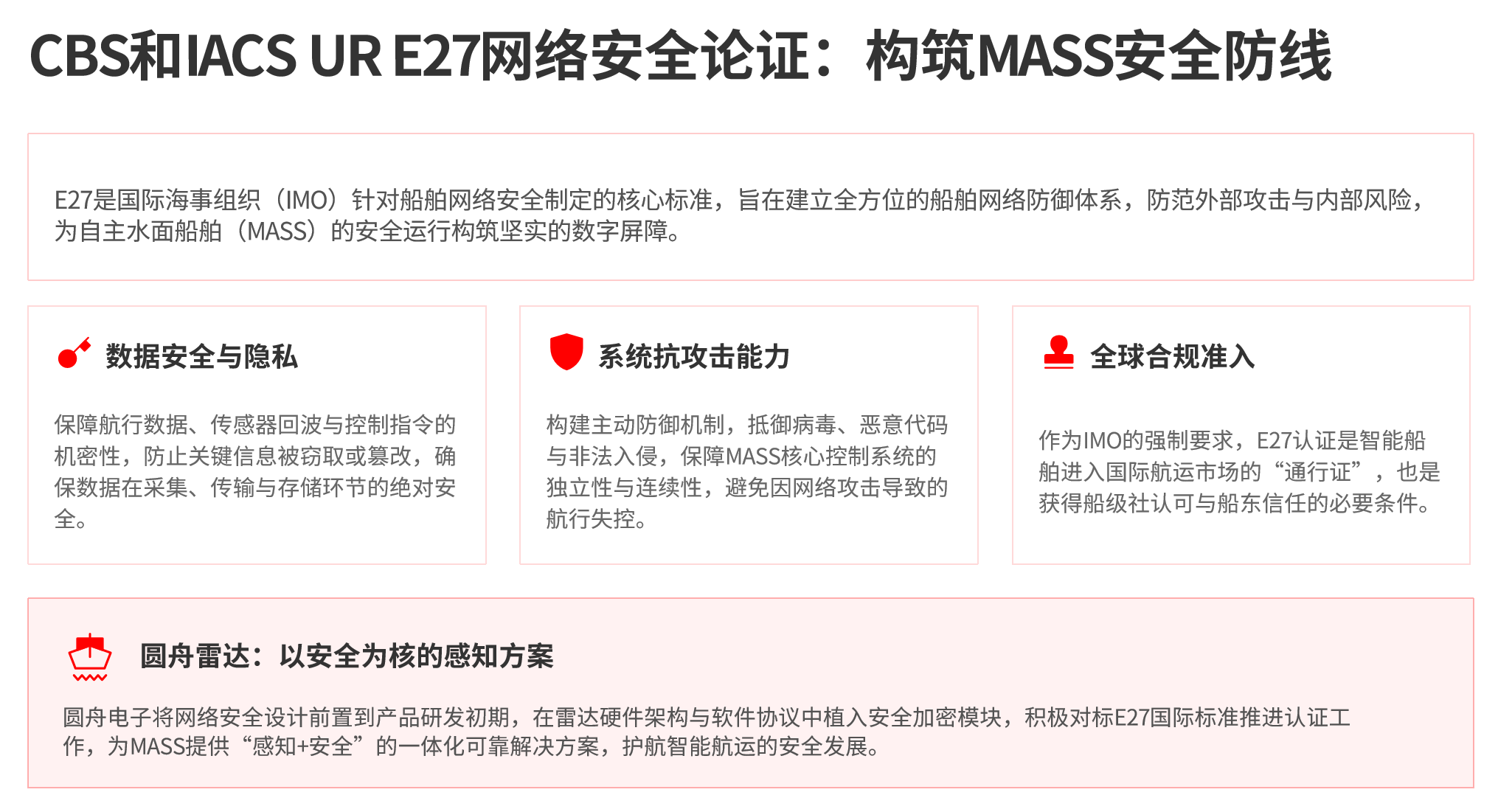
In addition to radar performance, the new code also emphasizes cybersecurity. CBS and IACS UR E27 are core standards formulated by IMO for ship cybersecurity, aimed at preventing external attacks and internal risks. E27 certification has become a passport for smart ships to enter the international market. Domestic radar manufacturers need to front-load cybersecurity design, embed security encryption modules into hardware architecture and software protocols, actively align with the E27 standard, and provide integrated perception and security solutions for MASS.
The implementation of the new MASS CODE is both a mandatory order for technological upgrading and a major opportunity for domestic brands to break through. It drives the industry to clear out low-end production capacity and forces high-quality industrial upgrading. As domestic ship intelligence retrofits accelerate, domestic radar brands with intelligent fusion technology, full-category product matrices, and international authoritative certifications will enter a critical window over the next 2–3 years to break through high-end barriers and reshape the industry landscape.
Case 1: Xilingxia Heyue (Unmanned Cruise Ship)

Case 2: Zhifei (Unmanned Cargo Ship)